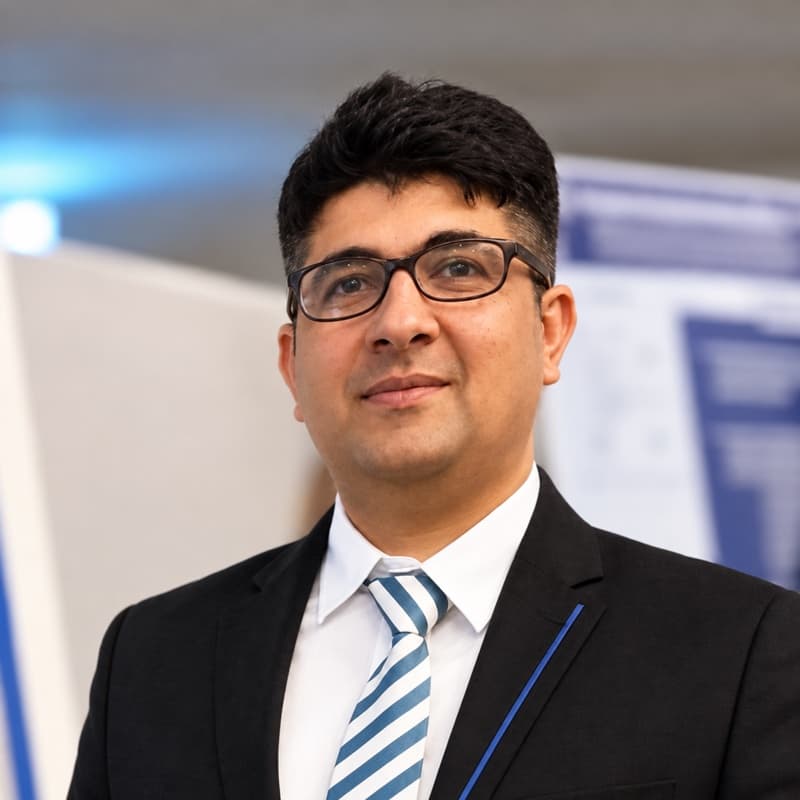
Profile
Professor Jonas E. Huber is Assistant Professor in the Department of Information Technology and Electrical Engineering at ETH Zurich and head of the Power Electronics and Drive Systems Laboratory. His research advances efficient, compact and sustainable electrical energy conversion. By combining converter topology, magnetic-component design, control, semiconductor technology and system-level optimisation, he develops power-electronic solutions for future grids, electric mobility, data centres, industrial drives and medical technology.
Research journey
His research journey is closely connected with ETH Zurich. He completed an MSc in Electrical Engineering with distinction in 2012, specialising in power electronics, drive systems and high-voltage technology. During his master’s training, an industry internship at ABB Switzerland introduced him to modular multilevel converters, while his thesis at ETH’s Power Electronic Systems Laboratory involved the design and construction of a high-power test platform for medium-frequency transformers.
He then joined the Power Electronic Systems Laboratory as a doctoral researcher and earned his PhD from ETH Zurich in 2016. His doctoral work focused on solid-state transformers: power-electronic systems that replace or augment conventional transformers while enabling higher-frequency isolation, controllable power flow and connections between AC and DC networks. His research addressed topology selection, multi-cell converter design, efficiency, power density, reliability, insulation stress, control and grid integration.
Research contribution and impact
After completing the doctorate, Professor Huber continued at ETH as a postdoctoral researcher and later became a senior scientist, lecturer and head of the Advanced Mechatronic Systems Group. This broader role expanded his work from solid-state transformers toward advanced converter architectures, electric drive systems, wide-bandgap semiconductors, ultra-high-bandwidth power amplifiers and multi-objective design methods that balance efficiency, volume, cost and environmental impact.
In 2026, he was appointed tenure-track Assistant Professor at ETH Zurich and established the Power Electronics and Drive Systems Laboratory. His current research combines fundamental converter innovation with application-driven engineering for sustainable electromobility, medical systems, AI-oriented data centres and modern energy infrastructure. A defining contribution of his work is the critical evaluation of when advanced power-electronic conversion adds real system value, supported by experimental prototypes, quantitative comparison and lifecycle-oriented design.
Areas of expertise
- Power electronics
- Solid-state transformers
- Electrical drive systems
- High-efficiency power conversion
- Electromobility and charging
- Sustainable converter design
In the network
With more than 97 research publications and a Google Scholar h-index of 32, Professor Huber has developed an influential record in power electronics and energy conversion. His work links rigorous analysis with hardware validation, helping define how future converters can achieve higher efficiency and power density while remaining reliable, resource-conscious and suitable for large-scale deployment.
Bibliometric values change over time; figures verified September 2026 from Google Scholar.