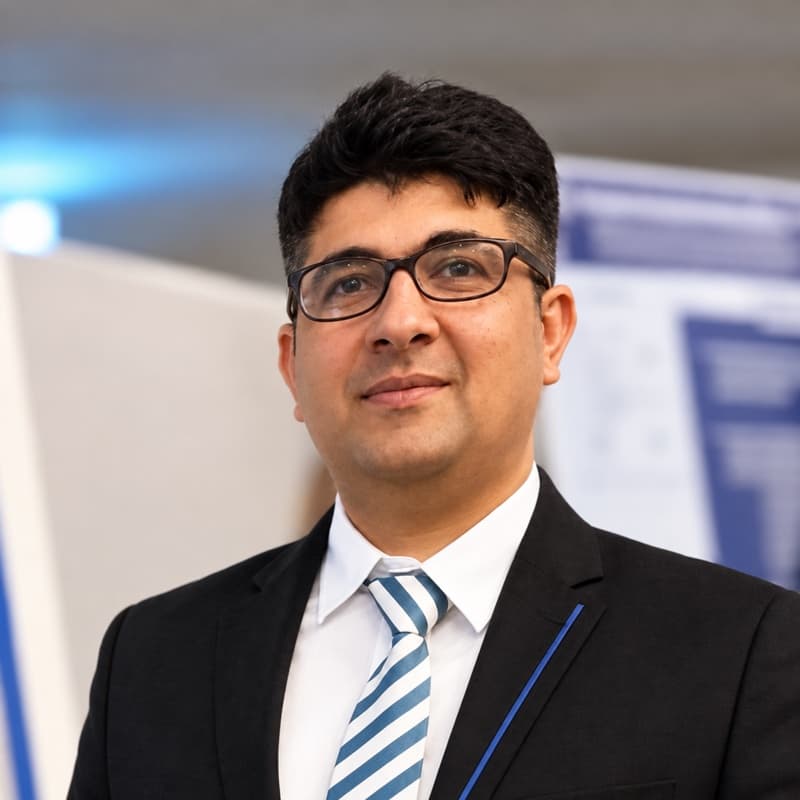
Profile
Professor Hedan Bai is Assistant Professor of Robotic Materials in the Department of Materials at ETH Zurich. She leads the Robotic Materials Group, an interdisciplinary team of materials scientists, chemists and roboticists developing soft materials that can sense, actuate, adapt and respond. Her work advances physical intelligence by embedding robotic functions directly into the structure and behaviour of materials.
Research journey
Her research journey developed through graduate training in mechanical engineering at Cornell University, where she earned master’s and doctoral degrees and worked in the Organic Robotics Laboratory. This environment brought together mechanics, polymer science, optics, sensing and fabrication, allowing her to approach robotics from the material level rather than beginning with conventional rigid machines and electronic control architectures.
At Cornell, she contributed to a series of influential soft-robotics technologies, including programmable camouflage surfaces, optically innervated devices, stretchable distributed fibre-optic sensors and self-sensing artificial muscles. These projects demonstrated how compliant materials can carry information, detect deformation and generate movement while remaining lightweight and highly deformable. The work helped establish her distinctive focus on integrating sensing and actuation into the physical body of a robot.
Research contribution and impact
Following her doctorate, Professor Bai joined Northwestern University as a postdoctoral researcher. Her work expanded into bioelectronics and implantable systems, exploring combinations of soft materials with high-performance electronic and sensing components. This period strengthened the biomedical dimension of her research and the possibility of creating devices that conform to living tissues, operate without conventional batteries and safely disappear after completing their function.
In 2023, she was appointed tenure-track Assistant Professor of Robotic Materials at ETH Zurich and established the Robotic Materials Group. Her current research aims to create soft robots that reproduce capabilities associated with living organisms, including autonomous sensing, adaptation, self-healing and environmentally responsive behaviour. By combining adaptive materials, optics, advanced manufacturing and bioelectronics, her group is developing robotic skins, fibre-based sensory networks, biodegradable machines and new forms of embodied intelligence.
Areas of expertise
- Robotic materials
- Soft robotics
- Stretchable optical sensing
- Adaptive and self-healing systems
- Bioelectronics
- Sustainable robotics
In the network
With 24 indexed research works and an h-index of 12, Professor Bai has built a highly visible early-career record in materials science and soft robotics. Her publications include research in Science, Science Robotics, Science Advances, Advanced Materials and Nature Biomedical Engineering. The central contribution of her work is a material-first vision of robotics in which sensing, motion, intelligence and lifecycle are designed together from the smallest functional elements upward.
Bibliometric values change over time; figures verified September 2026 from the scholar’s indexed research record.